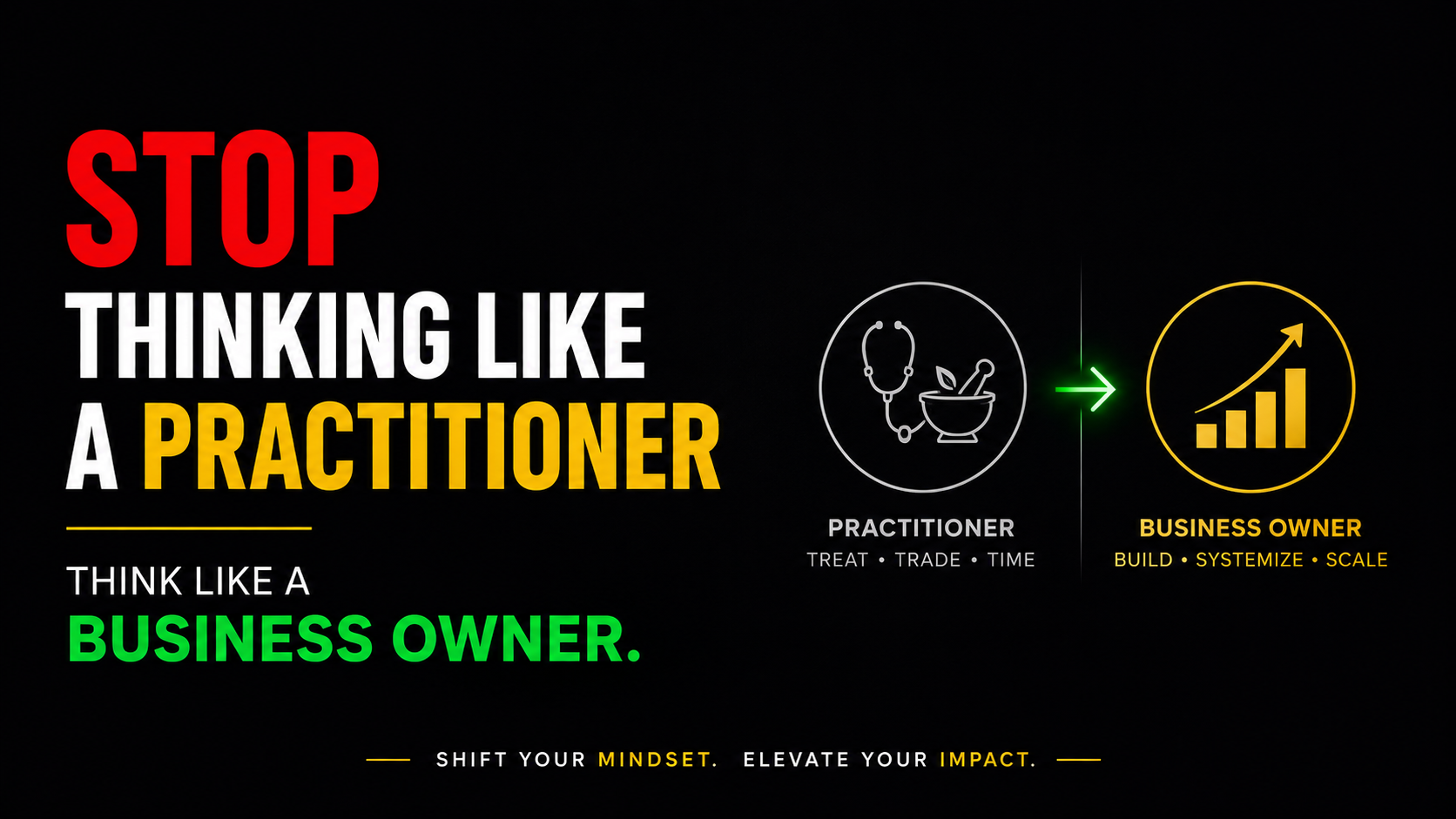
You became an Ayurvedic practitioner because you wanted to serve.
You studied Ayurveda.
You developed your skills.
You learned how to understand people and their health.
But somewhere along the journey, another reality appears:
Being a good practitioner does not automatically create a successful Ayurveda business.
You may have excellent knowledge and still struggle with:
- Getting noticed
- Attracting the right clients
- Communicating your value
- Creating consistent income
- Managing your time
- Building a team
- Growing beyond your personal effort
This is where many Ayurvedic entrepreneurs get stuck.
The problem is not that you need to become less of a practitioner.
The shift is that you need to become more than a practitioner.
You need to start thinking like an entrepreneur.
The Practitioner Mindset vs. The Entrepreneur Mindset
A practitioner naturally asks:
“How can I help this person?”
An entrepreneur also asks:
“How can I create a system that helps more people consistently?”
Both questions matter.
The first protects the quality of service.
The second creates scale and sustainability.
A business becomes powerful when both work together.
What Happens When You Think Like a Practitioner Only?
When everything depends on your personal effort, your business has a natural ceiling.
You personally:
- Consult every client
- Answer every WhatsApp message
- Explain the same things repeatedly
- Create every piece of content
- Handle every enquiry
- Follow up with everyone
- Make every decision
Eventually, you become busy.
But being busy is not the same as building a business.
Short Answer:
Thinking only like a practitioner can keep an Ayurveda entrepreneur focused on delivering the service while overlooking marketing, systems, sales, finances, and scalability.
Your expertise creates value.
But your business system distributes that value.
Your Clinical Skill Is the Foundation — Not the Entire Business
This distinction is important.
Your Ayurvedic knowledge is your foundation.
But a sustainable business also needs:
Expertise
What do you know?
Positioning
What are you known for?
Communication
How clearly can you explain your value?
Marketing
How will the right people discover you?
Sales
How will interested people become clients?
Systems
How will the business operate consistently?
Finance
How will the business remain sustainable?
Leadership
How will you eventually build something that does not depend entirely on you?
This is the difference between practicing Ayurveda and building an Ayurveda enterprise.
Myth: “If I Am Good Enough, People Will Automatically Find Me”
This is one of the most expensive beliefs an Ayurvedic entrepreneur can carry.
Being excellent is important.
But excellence does not automatically create visibility.
There may be hundreds of practitioners with excellent knowledge.
The person who communicates clearly and consistently may become better known.
That does not necessarily mean they are more knowledgeable.
It means they have learned how to communicate their knowledge to the market.
Marketing Is Not Self-Promotion
Many Ayurvedic practitioners hesitate when they hear the word marketing.
They think:
“I don’t want to advertise myself.”
But ethical marketing does not have to mean exaggeration or manipulation.
Marketing can simply mean:
Helping the right person understand that you can help them.
If people do not know:
- Who you are
- What you do
- Whom you serve
- What problem you solve
they cannot make an informed decision to work with you.
Visibility is therefore not necessarily ego.
It can be service through communication.
Stop Asking Only: “How Can I Get More Patients?”
Start asking better questions.
Instead of only asking:
“How can I get more patients?”
ask:
- What problem am I uniquely positioned to solve?
- Who do I serve best?
- Why should someone trust me?
- How can I educate before they become a client?
- Which part of my process can be systemized?
- How can I serve more people without exhausting myself?
These questions move you from practitioner thinking to entrepreneur thinking.
Build Assets, Not Just Daily Work
A practitioner often gets paid for today’s work.
An entrepreneur also builds assets that continue creating value.
For an Ayurvedic entrepreneur, these could include:
- A personal brand
- YouTube videos
- Blog articles
- Educational courses
- Webinars
- Communities
- Digital resources
- Standard operating procedures
- Automated communication systems
One good educational video can help people long after you have finished recording it.
One well-written article can continue attracting people through search.
One structured webinar can educate hundreds.
That is leverage.
Technology Can Multiply Your Effort
Technology should not replace your expertise.
It should extend it.
For example:
You know something once.
Create a video.
You explain something repeatedly.
Create an educational resource.
You answer the same enquiry every day.
Create a structured communication system.
You manually remind people.
Use automation where appropriate.
The goal is not to automate the relationship.
The goal is to automate repetitive work so you have more energy for meaningful work.
The Ayurvedic Entrepreneur Needs Both Seva and Sustainability
There is sometimes a false choice:
Service OR money.
But sustainable service requires resources.
A financially healthy Ayurveda business can provide:
- Better infrastructure
- Better team support
- Better educational resources
- More time for learning
- Wider community impact
Artha does not have to oppose Dharma.
When earned ethically and used wisely, financial sustainability can support your larger purpose.
A Simple 5-Level Mindset Shift
You don’t have to abandon your practitioner identity.
Expand it.
Level 1 — Practitioner
“I help people.”
Level 2 — Professional
“I provide valuable expertise.”
Level 3 — Brand
“I communicate what I stand for.”
Level 4 — Entrepreneur
“I build a sustainable business around my expertise.”
Level 5 — Leader
“I create systems and people that allow the mission to grow beyond my individual effort.”
This is the evolution.
Not Practitioner → Businessman.
But:
Practitioner → Entrepreneur → Leader
without losing the practitioner within you.
What Should You Start Doing Differently?
You don’t need to change everything tomorrow.
Start with these five questions every week.
1. What value did I create?
Not just how many hours did I work?
2. What did I learn about my audience?
Listen to their questions, fears, and needs.
3. What can I systemize?
Find one repetitive activity.
4. What asset am I building?
Create something that continues working after today.
5. What can I delegate?
Your time should gradually move toward higher-value activities.
These questions slowly change the way you see your business.
Frequently Asked Questions
Do Ayurvedic practitioners need to become businesspeople?
Yes, if they want to build a sustainable practice or Ayurveda enterprise. Business skills complement clinical expertise by helping practitioners manage visibility, revenue, systems, and growth.
Will thinking like an entrepreneur reduce my focus on Ayurveda?
No. The goal is not to replace Ayurvedic thinking but to build the business capabilities needed to express and expand your expertise sustainably.
Is marketing necessary for an Ayurvedic business?
Yes. Ethical marketing helps the right audience discover, understand, and trust your expertise.
Can an Ayurvedic entrepreneur grow without working more hours?
Yes. Systems, delegation, digital assets, education products, and automation can create leverage and reduce dependence on personal time.
What should I learn first as an Ayurvedic entrepreneur?
Start with positioning, communication, personal branding, basic marketing, and simple business systems. Build these progressively rather than trying to master everything at once.
Key Takeaways
- Clinical expertise is the foundation, not the complete business.
- Being a good practitioner does not automatically create visibility.
- Ethical marketing is a form of communication and service.
- Systems and technology can multiply your effort.
- Build digital assets instead of relying only on daily consultations.
- Financial sustainability can support your larger purpose.
- The goal is not to stop being a practitioner.
- The goal is to think beyond the practitioner role.
Your Ayurveda knowledge has value.
But knowledge sitting inside you can help only the people who happen to reach you.
When you learn to communicate it, more people can discover it.
When you build systems around it, more people can access it.
When you build a sustainable business around it, you can continue serving without constantly exhausting yourself.
So don’t stop being an Ayurvedic practitioner.
Expand your identity.
Think like a practitioner when you serve.
Think like an entrepreneur when you build.
Think like a leader when you scale.
Because your dharma may not be limited to how many people you can personally serve in one day.
It may also include how many people you can empower through the business you build.
And that is where Ayurveda entrepreneurship begins.